With Colorado River reservoirs at historic lows, new 2027 guidelines highlight how xeriscaping can help homeowners design beautiful, waterwise yards.
CLINTON, UT, UNITED STATES, September 22, 2026 /EINPresswire.com/ — As Western communities continue to face prolonged drought and pressure on water supplies, a recent federal decision on Colorado River management underscores the challenges facing the region’s water future. On Aug. 21, the U.S. Bureau of Reclamation finalized new guidelines for operating the river’s system in 2027 and 2028, as Lake Mead and Lake Powell reached record-low elevations in August after decades of drought.
For homeowners, the broader water-supply picture is prompting a closer look at landscape water use. Rather than simply trying to water an existing yard less, High Country Gardens experts say a longer-term approach is to design landscapes around the water realistically available in a particular climate and location.
WHAT XERISCAPING REALLY MEANS
Xeriscaping is a landscape-design approach that works with a site’s climate, water availability and growing conditions from the beginning. Rather than treating water conservation as an afterthought, it considers water needs as part of the overall design, including plant selection, layout, grouping, soil conditions and irrigation.
That does not mean replacing a landscape with rocks or eliminating plants. Often called “zeroscaping,” that sparse approach is different from the principles of xeriscaping, which can be used to create landscapes with flowering plants, foliage, seasonal color and varied textures while using water intentionally.
DESIGNING WITH WATER ZONES
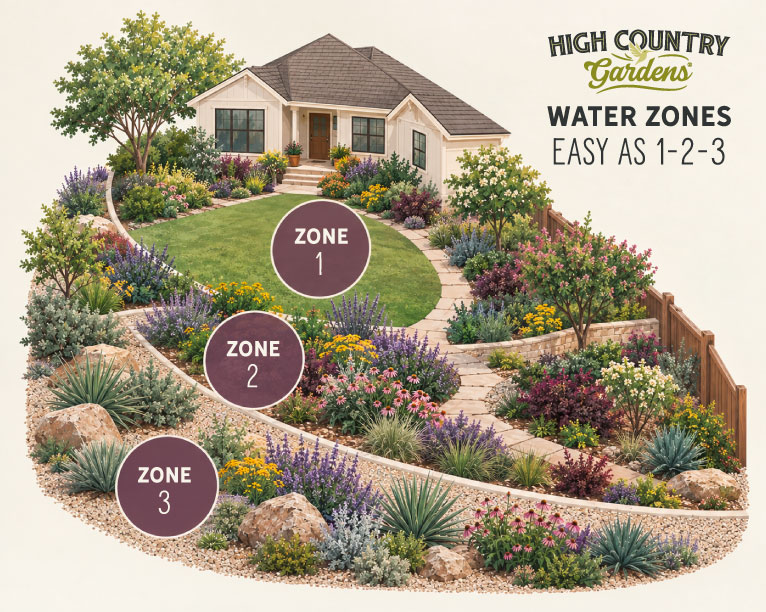
One of the practical foundations of xeriscaping is dividing a landscape according to how much supplemental water different areas can reasonably receive.
High Country Gardens organizes this approach around three basic water-use zones, sometimes called hydrozones:
• OASIS ZONE: Areas closest to the home or easiest to water, where plants with greater water needs can be concentrated.
• TRANSITION ZONE: Intermediate areas that receive moderate water and can support plants with moderate water needs.
• XERIC ZONE: Outer or less-accessible areas designed around plants that can thrive with significantly less supplemental water once established.
Thinking in hydrozones can help homeowners avoid treating an entire property as though every area has the same water requirements. Instead, water can be directed toward areas where it provides the greatest benefit, while plants suited to drier conditions can occupy areas with less access to supplemental irrigation.
This approach is part of a broader set of waterwise landscape principles that includes planning and design, appropriate plant selection, understanding soil conditions, turf management, efficient irrigation and ongoing maintenance.
“Gardening in the West can be tough, with huge temperature swings from day to night, rocky or infertile soils, scorching temperatures and droughts that can stretch longer each season,” says Lauren Carvalho, Horticultural Manager at High Country Gardens. “Choosing plants that are up to the task and resilient enough to withstand our climate’s increasing extremes can make all the difference. It starts with understanding your site, being realistic about its challenges and then leaning into those conditions with problem-solving plants. You can still experiment with combinations of texture and color and rearrange things as you learn what works best in your space.”
WHAT HOMEOWNERS CAN DO NOW: START WITH AN AUDIT, NOT A DEMOLITION
Adopting a waterwise landscape does not have to mean removing everything and starting over. For homeowners looking to use less supplemental water, the first step can simply be understanding where water is currently going.
START WITH AN AUDIT, not a demolition. Walk the property and identify where supplemental water is being used most heavily. Look for spaces that are difficult to irrigate efficiently, lightly used, or dominated by plants that need more water than the site naturally provides.
ZONE BEFORE PLANTING. Consider which areas of the yard naturally have greater access to water and which are better suited to plants that need less. Group plants with similar water requirements together rather than creating a landscape in which every area receives the same irrigation.
REPLACE STRATEGICALLY. A homeowner does not have to replace an entire lawn or garden at once. An underused side yard, difficult slope, strip of turf or other high-water area can be a place to begin.
UNDERSTAND YOUR SOIL. Soil type and drainage can influence whether a plant suited to a dry climate will actually perform well in a particular yard. Understanding the soil can help homeowners choose plants and locations more successfully.
USE IRRIGATION INTENTIONALLY. Where supplemental irrigation is needed, efficient systems and watering practices can help deliver water where plants need it. Once established, plants suited to the site can often be watered more deeply and less frequently rather than receiving frequent shallow watering.
DROUGHT TOLERANT IS NOT A LOCATION
A plant being labeled drought tolerant does not mean it will perform equally well in every dry climate or every part of a landscape. Climate, precipitation, soil, drainage, sun exposure, elevation and microclimates can all influence whether a plant will thrive with less supplemental water.
The key is matching the plant to the place. A sunny slope, an irrigated area near a foundation and a dry strip along a driveway can have very different growing conditions, even when they are only a few feet apart. Plants also need time to establish before supplemental watering can be reduced.
“Choosing the right plants for a Western garden really comes down to knowing your site,” says Kristina Bentz, Business Manager at High Country Gardens. “How quickly your soil drains, how much sun it receives and how much heat radiates from a nearby wall or driveway all matter. The mistake I see all the time is mixing plants with really different water needs in the same bed — say, planting a Hosta right next to a Salvia. You end up watering the whole bed to keep the Hosta happy, and that extra water is exactly what can end up rotting the Salvia. Group your plants by how thirsty they actually are, water each group accordingly, and the whole garden becomes a lot easier to take care of.”
A WATERWISE LANDSCAPE CAN STILL BE BEAUTIFUL
Water conservation can sometimes sound like a choice between an attractive garden and a garden designed to use water wisely. Xeriscaping approaches the question differently by treating water availability as one of the starting points for landscape design.
A well-planned waterwise landscape can include flowering plants, foliage, seasonal color, varied textures and habitat. It can also include areas with different water requirements, creating lush, inviting spaces where homeowners spend the most time while using less supplemental water in areas where lower-water plants are better suited.
High Country Gardens has focused on waterwise gardening in the West since horticulturist David Salman founded the company in 1993. His approach emphasized matching plants to challenging Western growing conditions and creating beautiful, waterwise gardens that could thrive in those conditions. Those principles continue to inform the company’s waterwise approach today.
As Western communities respond to drought and changing water supplies, xeriscaping offers one way to rethink how landscapes are designed and how landscape water is used. It does not require an entire-property makeover. For many homeowners, the process can begin with a lawn edge, side yard, slope or other area where the existing landscape demands more supplemental water than the site can realistically provide.
LEARN MORE ABOUT XERISCAPING AND WATERWISE LANDSCAPING FROM HIGH COUNTRY GARDENS
High Country Gardens’ waterwise resources address common questions about xeriscaping, plant selection, irrigation and designing sustainable landscapes for dry climates.
• How to Plan a Waterwise Garden or Xeriscape: https://www.highcountrygardens.com/blogs/waterwise/how-to-grow-a-waterwise-garden
• Xeriscaping vs Zeroscaping: https://www.highcountrygardens.com/blogs/in-the-news/debunk-xeriscape-myths
• Waterwise Learning Center: https://www.highcountrygardens.com/blogs/waterwise
• How to choose waterwise plants: https://www.highcountrygardens.com/blogs/waterwise/how-to-choose-waterwise-plants
ABOUT HIGH COUNTRY GARDENS
High Country Gardens believes Sustainability Begins In Your Backyard. As an online source for waterwise plants, gardening education and sustainable landscaping resources, High Country Gardens has helped gardeners create beautiful outdoor spaces suited to challenging Western conditions since 1993. Learn more about waterwise lawn alternatives and sustainable landscaping approaches at: https://www.highcountrygardens.com
Tabar Gifford
High Country Gardens
ltabar@americanmeadows.com
Visit us on social media:
Instagram
Facebook
YouTube
TikTok
Other
Sustainable gardens start with simple choices. See how waterwise plants create vibrant, pollinator-friendly landscapes that work with nature.
Legal Disclaimer:
EIN Presswire provides this news content “as is” without warranty of any kind. We do not accept any responsibility or liability
for the accuracy, content, images, videos, licenses, completeness, legality, or reliability of the information contained in this
article. If you have any complaints or copyright issues related to this article, kindly contact the author above.

Media gallery