
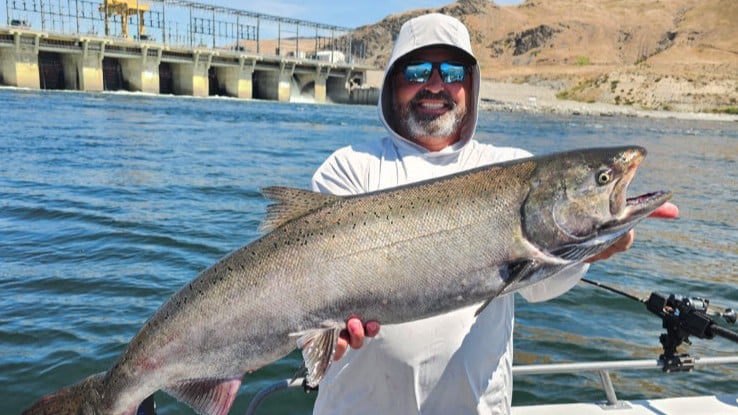
Buoy 10, where the Columbia River meets the Pacific Ocean near Astoria, Oregon, hosts one of the most significant salmon migrations on the West Coast each August. Anglers fishing this stretch routinely encounter both Chinook and Coho salmon, often within the same outing. While both species share size, color, and behavior overlaps at certain life stages, several reliable physical markers allow anglers to distinguish them, even before a fish reaches the boat.
Gum Line Color
The most definitive identification method is the gum line, the tissue along the base of the teeth on the lower jaw. Chinook salmon have black gums, while Coho salmon have white or pale gums. This distinction holds true regardless of the fish’s size, coloration, or how far it has traveled upriver, making it the most reliable check available once a fish is in hand or near the surface. Even when other features are ambiguous due to lighting or water clarity, a quick look inside the jaw resolves the question with near certainty.
Spotting Patterns
Spot distribution offers a strong secondary indicator. Chinook display irregular black spots across their entire tail fin, both lobes, and extending well up the back. Coho, by contrast, show spots only on the upper lobe of the tail and the upper back, with a noticeably cleaner lower tail section. Anglers who get a good look at a fish’s tail as it surfaces can often make the call before it’s netted. This is particularly useful at Buoy 10, where fish are frequently sighted or rolled boatside before landing, giving anglers a brief but workable window for a visual check.
Tail and Body Shape
Beyond spotting, the tail itself differs in shape. Chinook tails appear more squared off, while Coho tails are slightly more forked. Body shape also varies: Chinook tend to have a thicker, more torpedo-like profile, while Coho are typically more streamlined and slightly more elongated relative to their weight. The head shape can also offer a clue, as Chinook generally have a blockier, more robust head compared to the proportionally smaller, more tapered head of a Coho.
Size Considerations
Size alone isn’t a reliable identifier, since young Chinook (jacks) can be smaller than mature Coho, and the ranges overlap throughout the season. That said, fully mature Chinook at Buoy 10 generally run larger on average, often in the high teens to twenties of pounds, while Coho more typically land in the 8 to 12 pound range. Experts from Reel Time Fishing explain that size works best as a supporting clue rather than a standalone test, especially early in the season when smaller Chinook and larger Coho are both present in the same water.
Behavior in the Water
Many experienced anglers also note behavioral differences once a fish is hooked. Coho are often described as more acrobatic, with sharper runs and more surface activity, while Chinook tend to fight deeper and with more sustained pressure. While not a precise identification method, this behavioral difference can offer an early hint about which species is on the line before visual confirmation is possible. A fish that immediately heads for the surface and thrashes is more likely a Coho, while one that bulldogs toward the bottom is more often a Chinook.
Why Identification Matters
Accurate identification carries practical weight at Buoy 10, where retention regulations frequently differ between Chinook and Coho, and between hatchery and native fish of each species. Misidentifying a fish can result in retaining one that should have been released, so anglers are encouraged to check current regulations from the Oregon Department of Fish and Wildlife or Washington Department of Fish and Wildlife before each trip, since rules can shift in-season based on run strength. Knowing the difference also matters for anglers tracking their own catch against daily bag limits, which are often structured around species-specific retention windows.
Telling Chinook and Coho apart becomes second nature with repetition, but the gum line check remains the gold standard when any doubt exists. Combined with spotting patterns, tail shape, and general size cues, most anglers can confidently identify their catch within a few trips to the water, making each fishing tour at Buoy 10 a little more productive and a lot less guesswork.
Reel Time Fishing
toby@reeltimefishing.com
+1 208 790 2128
2131 Critchfield Rd
Clarkston
Washington
99403
United States


