
Key Takeaways
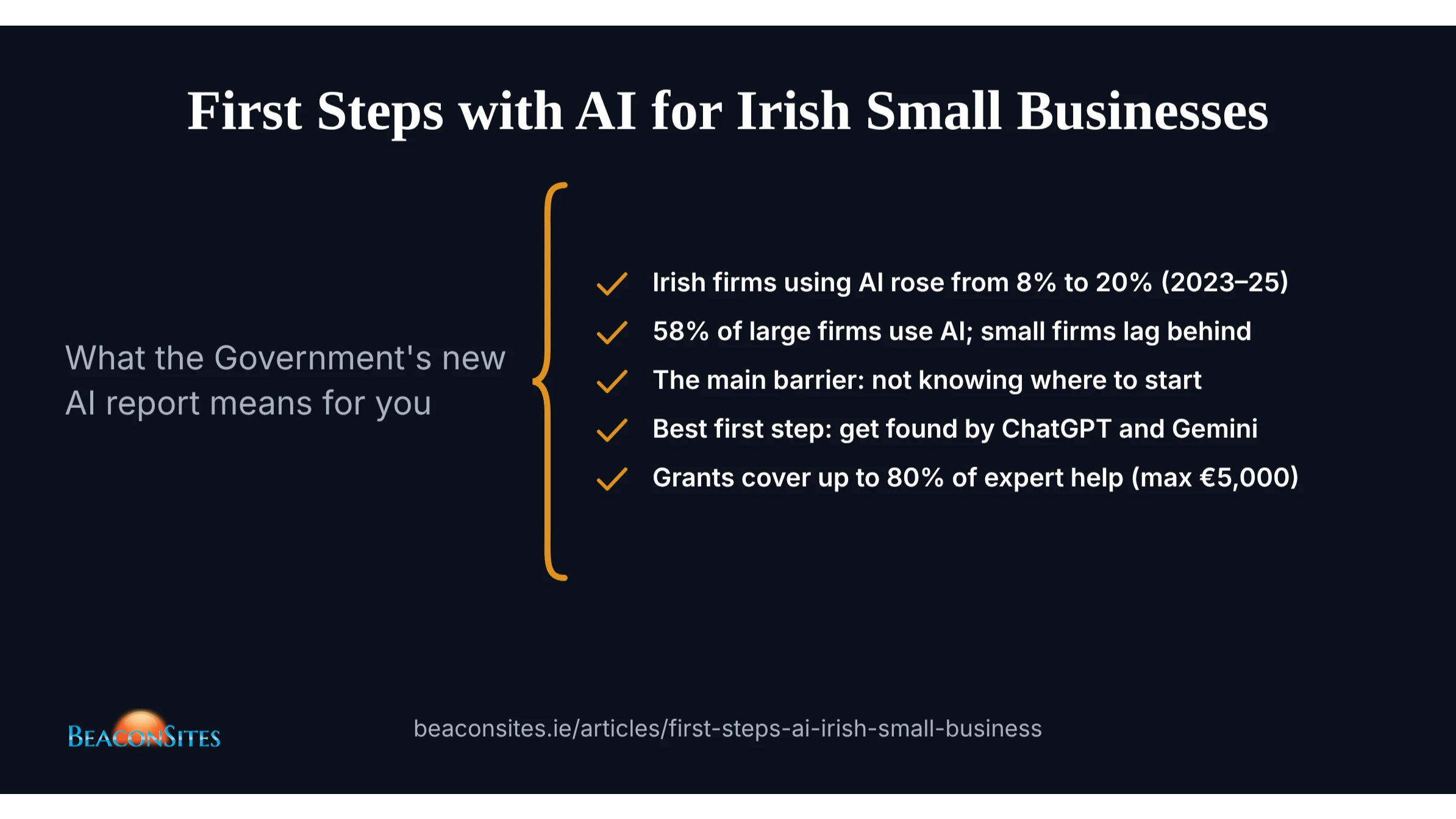
- A new Government-commissioned study finds AI use is still much more limited among Ireland’s small firms than among large companies, and the main hurdle is knowing where to start rather than cost
- The research behind the report drew on 272 enterprise consultation responses, interviews with more than 30 stakeholders, and four sector workshops involving 175 participants
- Checking whether ChatGPT, Gemini and Microsoft Copilot can find and correctly describe a business is a practical, low-cost first AI project for customer-facing firms
- Several Government supports, including Enterprise Ireland’s Digital Discovery funding, can help cover the cost of a first AI step once a business has picked one
- A simple self-check using five customer-style questions can reveal within 30 minutes whether AI assistants are sending business your way or leaving you out entirely
A new Government-backed report has landed on the desks of Irish business owners, and its message is hard to miss: small firms are falling behind on AI, mostly because they are not sure what to do first. For an owner-manager running a trade, a shop, or a professional practice, that uncertainty is the real obstacle, not the price of the tools.
Small Firms Lag Badly on AI
Large Irish companies have been moving steadily on AI for several years, while most small and micro businesses are either not using it at all or are limited to the odd one-off task, like tidying up an email in ChatGPT. The gap is wide enough to stand out in a new sector-wide Government study of AI adoption, and the reasons behind it are not simply small firms being slow or stubborn.
What the researchers found was less about reluctance and more about confusion. Owner-managers are busy running their businesses day to day, and working out which AI tool might help, whether it is worth the time, and how to judge if it actually worked, is a project most people keep putting off. This gap plays out most clearly around customer-facing AI tools, where the stakes are not just efficiency but whether a business gets found at all.
The practical upshot for any small business owner is that doing nothing is no longer a neutral choice. Larger competitors are already automating parts of their operations and, more importantly for most local businesses, customers are already using AI assistants to research who to buy from. Standing still means falling further behind on both fronts at once.
Inside the Government’s New Study
The report draws on a mix of official statistics, direct consultation, and workshop discussion, giving it a broader base than a single survey.
272 Responses, 30 Interviews, Four Workshops
The study combines 272 enterprise consultation responses with interviews involving more than 30 stakeholders and four sector workshops attended by 175 participants. That breadth lets the report speak with some authority about patterns across different industries, rather than relying on anecdote from a handful of firms.
The report’s findings point to the human side of the problem: not a lack of interest in AI, but a lack of time and confidence to work out where to begin. That distinction shapes much of what the report recommends later on.
Where Firms Actually Stand on AI Use
Among the businesses consulted, about half described only task-level AI use, meaning someone occasionally uses a tool like ChatGPT for a single job rather than building it into regular workflows. A smaller share, 15%, reported running a pilot project or having AI embedded into at least one workflow. Only 10% had reached a scaled or AI-native way of operating.
That split tells its own story. Most businesses consulted have dipped a toe in, few have built anything lasting, and almost none have restructured how they work around AI. For an owner-manager wondering whether they are behind, the honest answer is that most of their peers are in the same position.
Uncertainty, Not Cost, Is the Real Barrier
The report is candid that money is rarely the first obstacle. Firms struggle to identify the right use case, judge what a good outcome looks like, or connect an AI project back to anything resembling business value. For many small and medium firms, uncertainty beats finance as the first hurdle, and owner-manager time is often the real constraint behind that uncertainty.
A practical path forward is to write down the specific business problem first, including what it currently costs or limits, and to set a measurable result and timeframe before even looking at AI products. Mapping out three to five possible use cases and comparing them on impact, data readiness, and how quickly results could show up gives a business something concrete to decide between, rather than guessing.
The Customer Side the Report Barely Covers
The report focuses heavily on AI used inside a business: automating admin, supporting decisions, boosting productivity. What it covers far more lightly is the flip side, which is customers using AI themselves to decide who to buy from in the first place.
That gap matters because customer-facing AI use in Ireland is already significant. The report does touch on this in its tourism chapter, noting that AI is becoming another intermediary between visitors and businesses, and that small firms cannot individually influence how global AI platforms choose what to show. Its advice there, to make accurate, structured information easier for AI systems to find, was written with tourism in mind but applies just as well to a solicitor, a dentist, a kitchen fitter, or any small business whose customers might ask an AI assistant for a recommendation.
For a customer-facing business, this is arguably the more urgent half of the AI story. An internal AI tool might save a few hours a week. A customer asking ChatGPT or Copilot for a recommendation and never hearing a business mentioned is a lost enquiry, and most owner-managers have no idea whether that is already happening to them.
Why AI Visibility Fits the Report’s Own Test
The report’s own advice for a micro or small firm is refreshingly modest: pick one defined use case, run a simple readiness and risk assessment, assign a clear owner, and take one practical next step. Checking whether AI assistants can find and correctly describe a business meets every part of that test.
It counts as a single, defined use case rather than a vague ambition to try something with AI. The readiness check costs nothing beyond some time, since it can be run directly inside ChatGPT, Gemini and Copilot. The owner is obvious too, because the fixes that follow sit on a website the business already controls, not on some third-party platform with its own rules. And the link to revenue is far easier to see than most internal AI projects offer, since an AI recommendation that sends someone to enquire is a concrete, traceable outcome.
This approach also sidesteps the cost and complexity the report warns small firms about elsewhere. There is no new software to buy, no data infrastructure to build, and no staff retraining required before starting.
Check Yourself in 30 Minutes
Before spending a cent, any business can run its own readiness check using tools it probably already has open in a browser tab.
Five Questions to Ask ChatGPT, Gemini and Copilot
Open ChatGPT, Gemini and Microsoft Copilot, and ask each one the same five questions, swapping in the relevant service and town:
- “Who are the best [service] providers in [town]?”
- “How much does [service] cost in Ireland?”
- “What should I look for when hiring a [service] in [county]?”
- “What is [business name] and what does it offer?”
- “Is [business name] or [main competitor] better for [service]?”
For each answer, note whether the business was named correctly, named with errors, or left out altogether. It is worth paying attention to which competitors keep coming up and which websites the assistant cites as its sources, since those sites are likely the ones the AI trusts for that topic.
Three or more “left out” results across those five questions is a clear signal: customers who turn to AI assistants for recommendations are not hearing about the business at all, however strong its reputation might be offline.
What to Fix on Your Website First
Once the gaps are clear, the fixes tend to be the same regardless of trade or sector. These systems often pull from a business’s website, Google Business Profile, and online reviews when deciding how relevant and trustworthy it is. Location, service area, contact details, opening hours, pricing and common customer questions should all be easy to find, and kept consistent across a website and business profiles.
Practical starting points include:
- Opening each service page with a plain, direct answer to the question a customer is actually asking, rather than burying it under marketing copy
- Stating prices or price ranges, since a concrete figure gives an AI assistant something solid to quote back to a customer
Writing out location and service area in plain text, rather than only showing it on a map
- Adding an FAQ section to each service page, built around the actual questions raised during the self-check
- Adding structured data, sometimes called schema, that labels business, service and FAQ details for machines to read
- Keeping business name, address, phone number and service details identical across the website, Google Business Profile, and any directory listings
It is also worth checking the customer experience directly, including the mobile experience, contact forms, phone numbers and the booking or appointment process, to make sure claims made elsewhere are easy to verify once someone actually lands on the site.
Government Funding for a First AI Project
For businesses that want expert help rather than doing the self-check alone, there is Government funding built specifically for this kind of first step. Enterprise Ireland’s Digital Discovery support offers up to 80% grant funding, to a maximum of €5,000, to help a business bring in an expert and assess AI opportunities before committing to any major investment.
Local Enterprise Offices run two further supports worth checking. Digital for Business provides a digital and AI readiness review with a customised plan, described by the Department of Enterprise, Tourism and Employment as a free audit that gives a business a roadmap suited to its own situation. The Grow Digital Voucher offers up to €5,000 at 50% funding, aimed at introducing new software or AI tools for businesses already trading for a period of time.
Enterprise Ireland frames the wider adoption pathway in similar terms: assess digital, data and people readiness, identify and prioritise use cases, then test feasibility through a small proof of concept or pilot before planning anything wider. That staged approach matches the report’s own advice almost exactly, and it is worth remembering that a grant pays for help with a defined project. Knowing where a business already stands in AI search makes that project far easier to define before applying. Eligibility for any of these supports should be checked directly with Enterprise Ireland or the relevant Local Enterprise Office.
Mistakes That Stall a First AI Step
A handful of mistakes come up again and again when small businesses try to make a first move on AI, and most are avoidable with a bit of planning.
- Starting with a tool instead of a problem. The report’s own top barrier is firms that cannot identify the right use case in the first place. Installing a chatbot on a website achieves little if AI assistants never send anyone to that website to begin with.
- Ignoring wrong answers once they are found. If an AI assistant gives an old address, outdated prices, or lists a service that is no longer offered, customers tend to believe it. The facts need fixing on the website and listings first, before anything else.
- Treating a single check as the end of the job. AI answers shift as the underlying engines update, so a self-check run once and never repeated goes stale quickly; running it again every few months keeps the picture current.
- Writing for machines instead of people. Pages that answer a customer’s actual question in plain language tend to work well for both human readers and AI engines, so there is rarely a need to write differently for one audience over the other.
- Taking on too much at once. Choosing one routine task with easily checked results, setting a measurable goal, and testing with one task or a small team before expanding further tends to work better than rolling out several AI projects simultaneously.
- Skipping staff rules on data. Entering customer personal data into free public AI tools carries real risk; a business plan with a Data Processing Agreement, or a tool hosted within the EU, is the safer route whenever personal data is involved.
Start With One Problem, Not a Tool
Every thread in the report leads back to the same conclusion: the businesses that make progress with AI are the ones that start by naming a specific problem, rather than the ones that buy a tool and hope it finds a use. For a customer-facing Irish business, checking whether ChatGPT, Gemini and Copilot can find and correctly describe the business is as close to a ready-made first problem as exists, since the fix sits on a website already under the owner’s control and the outcome, a customer enquiry, is simple to measure.
A sensible way to start is one task, one or two people and a few weeks before extending any AI workflow further. The scale is small deliberately. A limited test with a clear owner and a measurable outcome tells a business far more about whether AI is worth its time than a sweeping rollout ever could, and it costs almost nothing to find out.
For a practical next move, consider the BeaconSites AI Visibility Audit as the starting point before deciding whether a wider AI project makes sense. The full guide, including the self-check and the funding options, is available at https://beaconsites.ie/articles/first-steps-ai-irish-small-business/
BeaconSites
info@beaconsites.com
+353 1 234 6662
77 Camden Street Lower
St. Kevins
Dublin
County Dublin
D02 XE80
Ireland


