
After rejecting status quo and deeper cuts, commissioners adopted a phased reduction that considered fishing communities and ecological management
NEWPORT, RI / ACCESS Newswire / November 11, 2026 / After narrowly rejecting status quo, Atlantic fisheries commissioners adopted a compromise Tuesday that cuts the menhaden quota while recognizing the economic consequences for fishing communities.
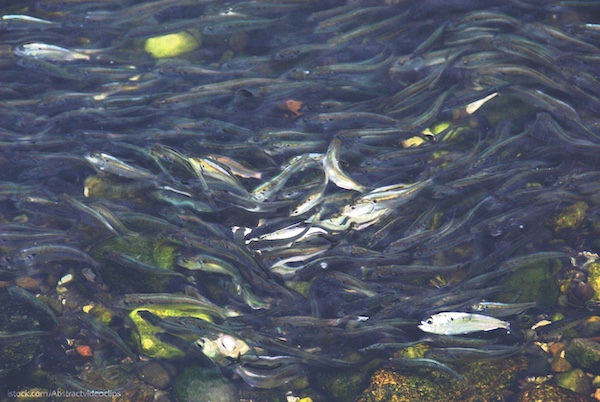
The Atlantic States Marine Fisheries Commission’s Atlantic Menhaden Management Board voted 11-7 to set the coastwide catch limit at 170,000 metric tons in 2027 and 155,000 metric tons in 2028. Those limits are approximately 9 percent and 17 percent below the 2026 quota of 186,840 metric tons, which had already been reduced by 20 percent from the preceding three-year quota.
Commissioners weighed ecological management alongside the livelihoods of lobster fishermen, bait suppliers, fishing crews and processing communities.
Then came the attacks from recreational fishing and environmental advocates.
The Forage Fish Campaign accused the commission of protecting a single foreign-owned company. The American Saltwater Guides Association said fishing industry representatives were among the “least scientifically educated” people in the room and suggested they cared only about their own wallets. Menhaden Defenders declared it a “dark day” and said the commission had done “exactly the wrong thing.”
For these organizations, a commission that listens to fishermen and considers economic consequences is worthy of contempt unless it delivers the exact outcome they demand.
A compromise after a close vote
Virginia Delegate Adele McClure first proposed keeping the existing quota for 2027 and 2028. The proposal failed 7-11; a shift of three votes would have changed the outcome.
Maine’s Megan Ware then introduced the phased reductions that ultimately passed. She told the board she was trying to balance the scientific projections with “very real economic consequences for our New England bait fisheries.”
Ware said the proposal would advance the ecological target while imposing real cuts. Local menhaden bait, she said, had helped keep Maine lobster businesses solvent as costs rose.
“This is clearly a very divided issue,” Ware told the board. “I’m asking that our bait fisheries not be collateral damage at the end of the day.”
McClure, who preferred status quo, acknowledged the close vote and states’ differing needs. She proposed a smaller reduction as a compromise and called for more time for science. Her amendment received no second.
The board subsequently rejected a Massachusetts proposal for deeper successive cuts before adopting Ware’s motion. Maine and Virginia, which had supported status quo, joined other delegations in voting for the final compromise.
The commission’s latest assessment found that Atlantic menhaden are not overfished and overfishing is not occurring. The ASMFC already manages the stock using ecological reference points that account for predators’ need for menhaden. The lower fishing mortality target is a management objective; the higher threshold determines when overfishing is occurring.
Contempt for the people in the room
The American Saltwater Guides Association’s response went well beyond disagreement with the vote. Its Facebook and Instagram post said the menhaden reduction and lobster bait industries “don’t care about sustainability,” accused their representatives of refusing to recognize science and portrayed their concern about economic consequences as simply “a hole in their wallet.”
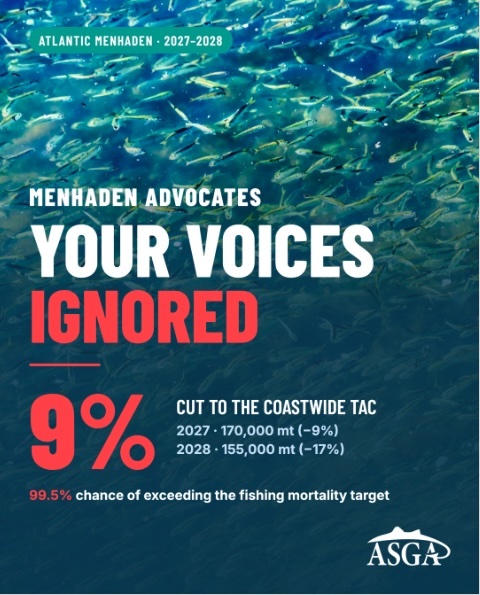
Those representatives included fishermen explaining bait costs, workers concerned about their jobs and families dependent on the fishery. Ware described Maine businesses kept afloat by local bait; McClure described the stakes for Virginia’s Northern Neck.
The guides association also mocked the commission for finishing in time for its annual dinner and dismissed the Potomac River Fisheries Commission as “not a real state.” It called the votes of the federal fisheries and wildlife agencies “rotten.”
That is the association’s response to public servants and fishing communities who declined to give it everything it wanted.
Menhaden Defenders likewise attacked the board for rejecting the deeper reduction and singled out New Jersey representatives. It thanked the seven states that opposed the final motion and offered “zero thanks” to the other voting jurisdictions and federal agencies.
The foreign ownership argument
The Forage Fish Campaign’s November 10 statement accused the commission of choosing a “foreign-owned industrial operation” over American fishermen and communities. The statement identified Omega Protein as a subsidiary of Canadian-owned Cooke Inc.
The campaign’s executive director, Whit Fosburgh, accused the commission of protecting the company. Jason Schratwieser, president of the International Game Fish Association, called for ending reduction fishing altogether. Mark Taylor, president of the Jersey Coast Anglers Association, criticized management of the spawning stock, and Philip Sciortino, owner of Tackle Box Inc., challenged the quota’s relationship to last year’s harvest.
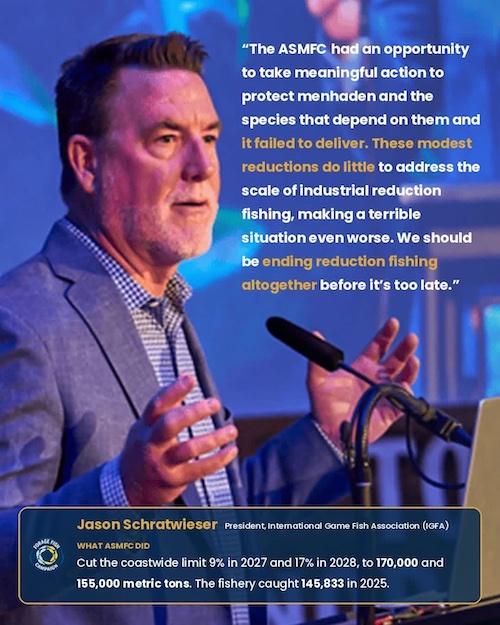
Fosburgh’s campaign keeps invoking Canadian ownership. The groups in its statement and others attacking the vote might look at the international companies supporting their own activities.
Schratwieser’s International Game Fish Association lists Costa Sunglasses, owned by the French-Italian EssilorLuxottica group, and Yamaha Rightwaters, a program of Yamaha, whose parent company is based in Japan, among the sponsors of the 2024 International Billfish Symposium it hosted with Wild Oceans. The association also thanked Costa for donating sunglasses, Yamaha Rightwaters for donating reusable water bottles, and Daiwa, a brand of Japan-based Globeride, for donating fishing equipment to its 2026 Cabo children’s fishing camp.
The American Saltwater Guides Association partnered with Costa on a fundraising shirt in 2020. The association said all revenue from the shirt would support its work.
Costa’s history makes those partnerships especially striking. After Costa was brought under the French-Italian EssilorLuxottica group, most of its longtime Daytona Beach operation was shut down, with hundreds of Florida workers affected.
Former Costa executive Al Perkinson went on to start Bajío Sunglasses in nearby New Smyrna Beach. He said he chose the location in part to provide jobs for some of the approximately 300 people he said had lost their jobs when Costa’s operation closed.
The recreational fishing groups that welcome support from Costa are quick to emphasize the Canadian ownership of a company whose Virginia operation supports American fishing and processing jobs. They might also consider what happened to the American workers in Costa’s own hometown.
The people behind the decision
Commercial fishermen and their families have a direct stake in healthy waters, sustainable fish populations, and the jobs, businesses and communities that depend on responsible access to the fishery.
UFCW Local 400, which represents menhaden fishermen, has urged lawmakers and the ASMFC to refrain from additional Chesapeake Bay restrictions until ongoing research establishes their necessity. The union has called for workers to have a voice in decisions affecting their livelihoods and said conservation and workers’ rights belong together.
The Southern Christian Leadership Conference warned Maryland Governor Wes Moore that further restrictions could disproportionately harm African American workers, union families and rural communities, and called for economic justice alongside environmental stewardship and sound science.
The NAACP Virginia State Conference also urged Virginia Governor Abigail Spanberger to protect working families while state-funded science is completed. Its president, Rev. Cozy Bailey, emphasized the health insurance, retirement benefits and family stability these jobs provide, and the scarcity of comparable employment in the Northern Neck.
Virginia commissioner Joseph Grist also pointed to a disparity in how the ASMFC had treated economic concerns the previous year. In the menhaden discussion, he said, socioeconomic impacts “was not something that really gained any traction.” The next day, he said, the striped bass board considered economic consequences in a fishery that was overfished. “There’s a disconnect,” Grist told the board.
The ASMFC’s striped bass board declined a proposed 12 percent reduction in 2025, citing severe economic consequences among its reasons. The American Sportfishing Association had urged status quo and applauded the decision. Economic concerns were worthy of consideration when recreational fishing was affected; menhaden fishermen and their families deserve the same consideration.
Commissioners heard those concerns and calls for deeper reductions. They rejected status quo and a substantially larger cut, then adopted a phased compromise.
The organizations attacking them responded by insulting fishermen, disparaging commissioners and suggesting that anyone who disagrees must be serving a corporate agenda.
Their response says more about their approach to disagreement than the people who worked to reach a decision.
Sources
American Saltwater Guides Association. (2020). Costa and ASGA team up!
American Saltwater Guides Association. (2026). Statement on the Atlantic Menhaden Management Board’s November 10 vote [Facebook and Instagram post supplied for this draft].
American Sportfishing Association. Striped bass.
American Sportfishing Association. (2025). Mixed results from 2025 ASMFC annual meeting.
Atlantic States Marine Fisheries Commission. Atlantic menhaden. Retrieved November 11, 2026.
Atlantic States Marine Fisheries Commission. (2025, October). ASMFC Atlantic Striped Bass Board approves Addendum III without reductions in fishery removals [Press release].
Atlantic States Marine Fisheries Commission, Atlantic Menhaden Management Board. (2026, November 10). Meeting proceedings Remarks cited: Megan Ware, approximately 2:43:18; Adele McClure, approximately 2:55:34; Joseph Grist, approximately 2:02:42-2:03:40.
Forage Fish Campaign. (2026, November 10). Atlantic States Marine Fisheries Commission ignores mounting scientific evidence, refuses to implement meaningful cut to coastwide menhaden quota [Press release].
International Game Fish Association. (2024, October 30). Global success: Highlights and key takeaways from the 7th International Billfish Symposium on Conservation and Management.
International Game Fish Association. (2026, June 19). The IGFA returns for the second annual Cabo Kids Fishing Camp-Campamento de Pesca Deportiva!
Menhaden Defenders. (2026). Statement on the Atlantic Menhaden Management Board’s November 10 vote [Facebook post supplied for this draft].
NAACP Virginia State Conference. Protecting Northern Neck workers and communities from additional menhaden restrictions [Letter to Governor Abigail Spanberger].
Shop Eat Surf Outdoor. Luxottica comments on Costa’s significant job cuts.
Southern Christian Leadership Conference. (2026, June 30). Letter to Maryland Governor Wes Moore concerning the Atlantic menhaden fishery. United Food and Commercial Workers Local 400. (2026, October 27). UFCW Local 400 statement on proposed Chesapeake Bay menhaden cuts.
Xpert Fly Fisher. (2021, March 31). Bajio Sunglasses is expected to open on April 1 in New Smyrna Beach.
About the American Small Pelagics Network
The American Small Pelagics Network represents fishermen, processors, suppliers, and coastal communities connected to fisheries such as menhaden, mackerel, herring, squid, and butterfish. ASPN supports sustainable fisheries management that supports critical fish species, while maintaining economic opportunities for fishermen and fishing communities.
Press Contact
Stove Boat Communications
202-595-1212
contact@smallpelagics.com
SOURCE: American Small Pelagics Network
View the original press release on ACCESS Newswire
Media gallery


